
If you’ve ever rolled your eyes at someone saying, “You’re such a Leo!” I get it. How can the sign the sun was on the day anyone was born really mean something about your personality?
Mainstream astrology has reduced down astrology to bite-sized horoscopes, identity labels and transiting predictions all based around someone’s sun sign. As fun and lighthearted this approach can be, as a therapist, I find it can actually cause harm. Like astrologers who claim to predict when you’ll get married, what sign is the right romantic fit or when you should quit your job. I find this type of astrology more harmful than helpful, it keeps the person disempowered to the stars and other’s interpretations of what the signs and the planets mean.
I’ve discovered a whole different lens of astrology, through Shamanic Astrology (more on that in this post HERE), where your natal chart serves as an empowering tool that helps guide you into a deep inquiry of yourself. When you understand the birth chart not as a prescriptive list of traits or outcomes, but as a map of archetypal energies, you begin to engage it like a living conversation, with your conscious mind in the driver seat.
Jung, Archetypes, and the Language of the Soul
Combining astrology and psychology isn’t some New Age trend. It actually has deep roots, reaching back to one of the forefathers of modern psychology.
Carl Jung, was a renowned Swiss psychiatrist and founder of Jungian psychology, a framework that continues to shape so much of today’s therapeutic and self-development work. Many people know Jung for his exploration of archetypes, defined as universal patterns and energies that live in the collective unconscious. But what fewer people realize is that Jung was also deeply interested in astrology.
He once wrote, “Astrology represents the sum of all the psychological knowledge of antiquity.”
To Jung, the planets and signs were never about fortune telling, they were symbols of the psyche, and a tool he saw as an ancient form of psychology. He credited astrology as the earliest system used to map one’s inner world, to better understand the invisible threads that shape our behaviors and life themes.
When I work with astrology, I hold it in this same spirit. It’s not about labeling yourself or predicting your future. It’s about entering into a dialogue with your inner world. It’s about listening more closely to the parts of you that are longing to be seen, expressed, healed, or reclaimed.
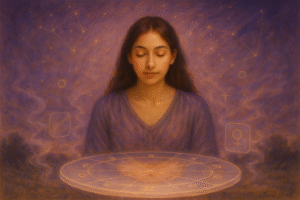
So… is astrology just woo?
Sure, in today’s culture, anything that isn’t measurable or peer-reviewed often gets tossed into the “woo” bucket. But maybe that says more about our discomfort with the unseen than it does about the system itself.
The truth is, astrology is one of the oldest symbolic systems we have for understanding human nature. While modern psychology leans on data and diagnostic criteria, astrology speaks through myth, archetype, and cosmic timing. It was used across ancient civilizations, from Mesopotamia to Egypt to Greece, and honored by the Native American Tribes, not as superstition, but as a tool for tracking the rhythms of the soul.
In my work, I don’t treat astrology as a belief system or a prediction engine. I treat it as a mirror, a way to see yourself more clearly. Just like CBT or Jungian dreamwork or somatic therapy, it’s a framework for exploring the psyche… just one that happens to include the stars.
So yes, astrology might be considered woo. But it’s also wise.
And when approached with reverence, curiosity, and grounded psychological insight, it can become a deeply empowering path of self-discovery, and dare I say a more enjoyable approach to healing.